In grain silos, flour mills, food warehouses and processing plants, a handful of moth species cause the majority of stored-product losses: the Indianmeal moth (Plodia interpunctella), the tobacco moth (Ephestia elutella), the almond moth (Cadra cautella) and the Mediterranean flour moth (Ephestia kuehniella). Larvae contaminate far more product than they consume, and webbing in packaged goods is a direct audit and recall risk. The industry-standard first line of defense is also one of the oldest tools in modern pest management: pheromone monitoring traps.
Key Facts
- The Indianmeal moth, Plodia interpunctella, is the most widespread stored-product moth pest in food facilities worldwide.
- Under warm storage conditions (~28–30 °C) the Indianmeal moth can complete its full life cycle in about 4–6 weeks, allowing several overlapping generations per year.
- Development essentially stops at cool temperatures; holding bulk product below roughly 18 °C is a recognized cultural control against these moths.
- Indianmeal moth, tobacco moth and almond moth share major pheromone components — a fact that simplifies monitoring and enables multi-species mating disruption.
- The first insect sex pheromone ever identified, bombykol (from the silkworm moth), was characterized in 1959 — the scientific foundation of the entire pheromone pest-control industry.
Why Pheromone Traps Belong in Every Food Facility
Stored-product moths hide inside packaging, in seams of equipment and in ceiling voids. Visual inspection finds them only after populations are established, when the cheapest intervention window has already passed. A pheromone trap works differently: it exploits the males' ability to follow the female's sex pheromone plume over long distances, so even a small resident population shows up as catch numbers within days.
For facility managers and QA teams, that produces three concrete benefits:
- Early detection: catch data flags activity weeks before larvae or webbing appear in salable product.
- Source location: because catches map spatially, a rising cluster of traps points directly at the pallet, room or piece of equipment where breeding is happening.
- Documented verification: time-series catch records demonstrate program effectiveness to auditors and customers — a growing expectation in food-safety schemes.
How an Indianmeal Moth Pheromone Trap Works
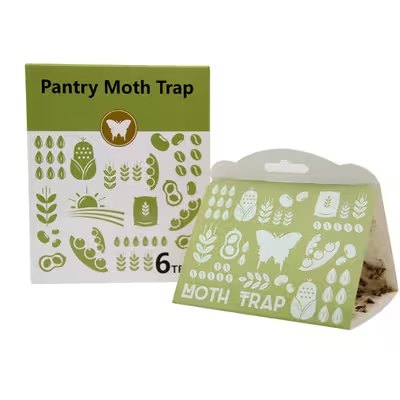
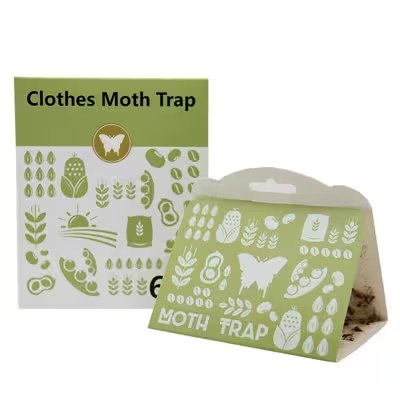
Each trap combines a controlled-release pheromone lure — usually a rubber septum or impregnated matrix inside a foil pouch — with a sticky surface, commonly folded into a delta-style cardboard housing. The lure emits a synthetic copy of the female sex pheromone; males fly up the gradient and are held on the adhesive insert. Nothing is sprayed, no product is contacted, and the technique is species-specific: beneficial insects, birds and people are unaffected.
One chemistry note that matters for buyers: the key pheromone components of Plodia interpunctella, Ephestia elutella and Cadra cautella overlap substantially, which is why a single well-formulated lure can be attractive to several of these species at once, and why trap identification of which species was caught sometimes requires a closer look. Pherobio supplies both single-species lures and combined blends, matched to the species profile of your commodity and region.
Trap Placement and Density in Warehouses
Placement drives the quality of the data more than any other factor. Rules that hold across facility types:
- Height: hang or place traps at roughly 1.5–2 m (eye level). Moths rest and mate preferentially at higher elevations; floor-level traps underperform.
- Spacing: keep traps 10–15 m or more apart — two traps too close compete with each other and skew counts.
- Grid density: a common starting grid is one trap every 15–25 m, approximately one per 300–500 m² of floor area, denser in high-risk zones such as dock doors, packaging lines and returned-goods areas.
- Hotspot priority: corners, ceiling/roof voids, equipment bases, spill zones and areas with warm microclimates.
- What to avoid: do not place traps in air currents from vents or near bright lighting, which interfere with the pheromone plume; keep them away from strong cleaning chemicals.
Read traps on a fixed schedule — weekly is standard in commercial programs — and log counts on a floor plan. A single trap with high counts is a curiosity; three adjacent traps with rising counts is a source location. That difference is exactly what the grid is designed to reveal.
From Monitoring to Control: The IPM Ladder
Pheromone traps detect and monitor; they are the sensing layer of an integrated program, not the whole program. A typical escalation ladder in food facilities:
- Monitor: permanent trap grid, weekly counts, floor-plan mapping.
- Sanitation and exclusion: targeted cleaning of the identified source area, spill removal, sealing of voids and dock seals.
- Physical control: temperature management (cooling bulk product), hermetic or airtight storage for susceptible commodities, light management.
- Pheromone-based population suppression: mass trapping at higher trap densities, and mating disruption — flooding the enclosed airspace with synthetic pheromone so males cannot locate females, collapsing the next generation's egg lay.
- Targeted intervention: where other tools are insufficient, apply approved treatments precisely and locally, respecting all local registrations and label requirements.
Mating Disruption: The Stored-Product Advantage
Mating disruption (MD) is an established pheromone tactic in orchards and vineyards — its requirements there include large contiguous areas of at least ~10 hectares. Stored-product settings offer a structural advantage: the treatment area is an enclosed volume, so pheromone does not blow away. Because Indianmeal moth, tobacco moth and almond moth share key pheromone components, a suitably formulated MD program can act on several species at once inside one facility. Combined with a monitoring grid — where catches near zero inside a treated volume confirm coverage — MD gives food facilities a residue-free layer of population suppression that fits naturally with sanitation and physical controls. Pherobio manufactures both mating disruption dispensers and monitoring lures for stored-product species in-house.
What to Look for in a Supplier
For distributors, food-processing groups and pest-management companies buying in volume, the evaluation criteria are consistent: pheromone purity and blend accuracy verified batch by batch, foil-packaged lures with a defined shelf life, trap bodies that survive dusty industrial conditions, and a supplier that can align product specs with the species present in your market. Pherobio Technology has manufactured insect pheromone products since 2003, with 200+ products in the portfolio, in-house semiochemical synthesis and exports across the Americas, Europe, Africa and Asia. Whether you need a private-label pantry moth trap line or facility-scale monitoring plus MD programs, contact our team for specifications and volumes.
Key Takeaways
Indianmeal moth and its relatives are found visually only after damage is done — pheromone traps find them first. Use a grid of sticky traps with quality lures at eye level, spaced 10–15 m apart, read weekly and mapped on a floor plan to locate sources. Escalate through sanitation, physical controls and pheromone-based mating disruption, which in enclosed facilities can cover several moth species at once.
Frequently Asked Questions
What is an Indianmeal moth pheromone trap and how does it work?
It is a sticky trap baited with a synthetic copy of the female Indianmeal moth (Plodia interpunctella) sex pheromone. Male moths follow the scent and become stuck on the insert, providing a sensitive early warning of moth activity long before larvae or webbing become visible in product.
Where should pantry moth pheromone traps be placed in a warehouse?
At eye level (about 1.5–2 m) near bulk storage, dock doors, corners and ceiling voids where moths congregate — not in ventilation streams or next to lights. Keep traps at least 10–15 m apart so one trap does not compete with another.
How many pheromone traps does a food facility need?
A common starting grid is one trap every 15–25 m, roughly one per 300–500 m² of floor area, with higher density in infested zones. Always map counts on a floor plan — spatial clusters are what locate breeding sources.
How long do stored product pheromone lures last?
Typically 6–8 weeks under ambient warehouse conditions. Replace all lures on a fixed schedule, and keep foil pouches sealed until the moment of installation.
Can mating disruption work against stored product moths?
Yes. Because Indianmeal moth, tobacco moth, almond moth and related species share key pheromone components, a suitably formulated mating disruption program can suppress mating of several species simultaneously within an enclosed facility — a practical advantage unique to the stored-product context.